
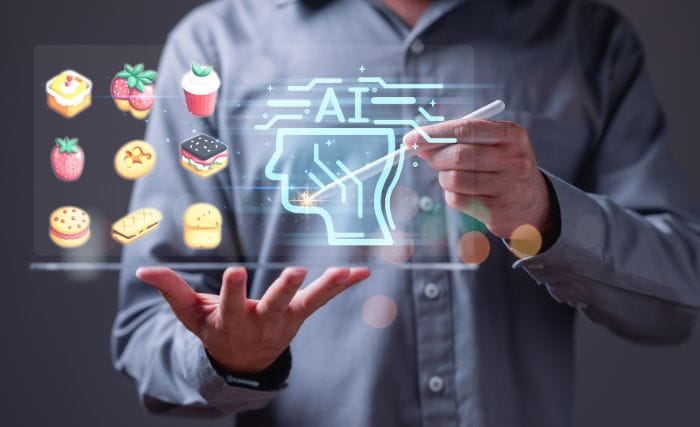
There is no shortage of AI hype in food and beverage manufacturing right now.
Vendors promise transformation; case studies cite extraordinary numbers. Beyond that, senior leaders are being asked to make major investment decisions in a market where, frankly, the noise is hard to separate from the signal.
So is AI worth it for food production? In the right areas, with the right foundations and a clear commercial rationale: yes, genuinely. For others, it is an expensive distraction, but that’s where a sound AI strategy for food manufacturers is crucial.
Is AI Worth It for Food Production?
Starting With the Business Case
Before getting into specifics, it’s definitely worth being direct about something that often gets glossed over in digital transformation conversations: AI is only worth it if it is solving a problem that’s actually costing you money.
The businesses I see getting genuine return from their food and beverage digital transformation are not the ones that started with a commercial problem, quantified the cost of that problem and then asked whether AI was the right tool to address it.
It’s that sequence that matters because technology-first thinking tends to produce impressive pilots and disappointing P&Ls.
Predictive Quality Control and AI Strategy for Food Manufacturers
Quality control is where the commercial case for AI in food manufacturing is most straightforward and where adoption is most mature.
The highest-value capability here is not as much detection but prediction. AI models can correlate real-time process parameters, including temperature profiles, ingredient batch characteristics, mixing times and equipment signatures with historical quality outcomes. This then allows them to forecast end-product quality before lab testing confirms it.
That means quality managers can intervene hours before failures would otherwise materialise at the finished goods stage.
AI inspection systems consistently outperform manual inspection in both speed and consistency; they have a particular strength in detecting subtle defects that human inspectors routinely miss under fatigue.
For food manufacturers already dealing with the cost of rework, write-offs, and the reputational risk of product recalls, this is a direct commercial argument.
McKinsey research on manufacturing AI deployments shows companies achieving 2 to 3x ROI within three years and 4 to 5x within five years. Payback periods of 12 to 18 months are widely modelled for quality control implementations, though individual results depend heavily on existing data infrastructure, production volume, and baseline defect rates.
The only caveat here is data quality.
AI quality models are only as good as the process data feeding them. If your production data is incomplete, inconsistently recorded, or siloed across systems that do not talk to each other, a quality AI implementation will surface that problem before it delivers any value.
That is not a reason to avoid it. It is a reason to treat data infrastructure as part of the investment, not an afterthought.
Weighing Up AI Investment for Your Food or Beverage Operation?
With decades of experience providing consultancy and strategy solutions to businesses across sectors, I help food manufacturers cut through the noise and build a commercial case that holds up. Get in touch today to find out how I can help you.
Demand Forecasting: The Underestimated Lever in Food and Beverage Digital Transformation
Demand forecasting is where I see the biggest gap between what AI can do and what most food manufacturers are currently doing.
Traditional forecasting in food and beverage relies on historical sales data, seasonal rules of thumb, and, more often than not, the accumulated instinct of an experienced planning team. That approach is not wrong.
But it struggles with the variables that increasingly drive demand: weather patterns, promotional calendars, regional events, input cost volatility, and the erratic consumer behaviour that has characterised the market since 2020.
AI-powered demand forecasting processes all of those variables simultaneously and updates in real time. Nestlé reported a 30% reduction in demand forecast error after rolling out AI-based forecasting. AI-powered demand forecasting reduces food waste by up to 30 to 40%, directly addressing one of the most significant cost pressures in food production.
The downstream effects of better forecasting compound quickly.
More accurate production scheduling means fewer last-minute line changeovers.
Better raw material planning means less over-ordering of perishable inputs, and improved finished goods accuracy means less end-of-line write-off. The forecasting improvement itself is the headline, but the operational savings that flow from it are often larger.
The integration is a crucial step.
AI forecasting tools need to connect to your ERP, your sales data and ideally your retail or customer demand signals. Where that data infrastructure exists, the implementation is relatively straightforward. Where it does not, that becomes part of the project scope.
It’s also worth being honest about that upfront rather than discovering it mid-implementation.
Waste Reduction is Where AI Strategy and Sustainability Converge
Waste is a cost and a compliance issue, and in the current operating environment it is increasingly both at once.
Food and beverage companies adopting AI-powered automation in 2026 are achieving up to 30% reductions in food waste and 25% improvements in supply chain accuracy. Those numbers are real, but they require a specific set of conditions to materialise: reliable production data, integrated systems, and the operational discipline to act on AI recommendations rather than override them out of habit.
The waste reduction use cases where AI adds the most consistent value in food manufacturing fall into three areas: yield optimisation, shelf-life prediction, and production scheduling.
In yield optimisation, AI analyses batch-level variables to close the gap between actual and optimal yield from raw materials. Shelf-life prediction uses machine learning models to flag spoilage risk and enable smarter stock rotation. And in production scheduling, AI reduces the overproduction that creates write-offs at the end of a run.
Food manufacturers using AI-driven systems report 35% fewer quality defects, 25% less unplanned downtime, and up to a 20% reduction in ingredient waste. For a business running on tight margins, those figures are not marginal. They are strategic.
Want to Build a Bespoke AI Strategy for Food Manufacturing?
I work with food and beverage manufacturers who need a commercially grounded view of digital transformation rather than a vendor pitch.
My work spans Strategy and Business Growth, Digital Strategy and Business Process and Performance with direct experience across the food and beverage sector.
If you want an honest, experienced view on where AI earns its place in your business, then get in touch today.
FAQ
Is AI worth it for food production?
In the right areas, the commercial case is well established. Quality control, demand forecasting, and waste reduction are all delivering measurable return for food manufacturers. The hype surrounds broad transformation claims. The reality is more specific and more achievable than that.
Where does AI add value in food manufacturing?
Predictive quality control and demand forecasting can both deliver return without wholesale systems replacement, provided your production data is reliable and your ERP can integrate with the relevant tools. Start narrow, prove the case, then scale.
What should a food and beverage digital transformation strategy include before any AI investment?
A clear problem statement, a quantified cost of that problem, an honest assessment of your data infrastructure, and a defined success metric. Technology without that foundation tends to produce impressive pilots and poor commercial outcomes.